Heading to Tak or Myanmar? The Warning Sign You Can’t Ignore
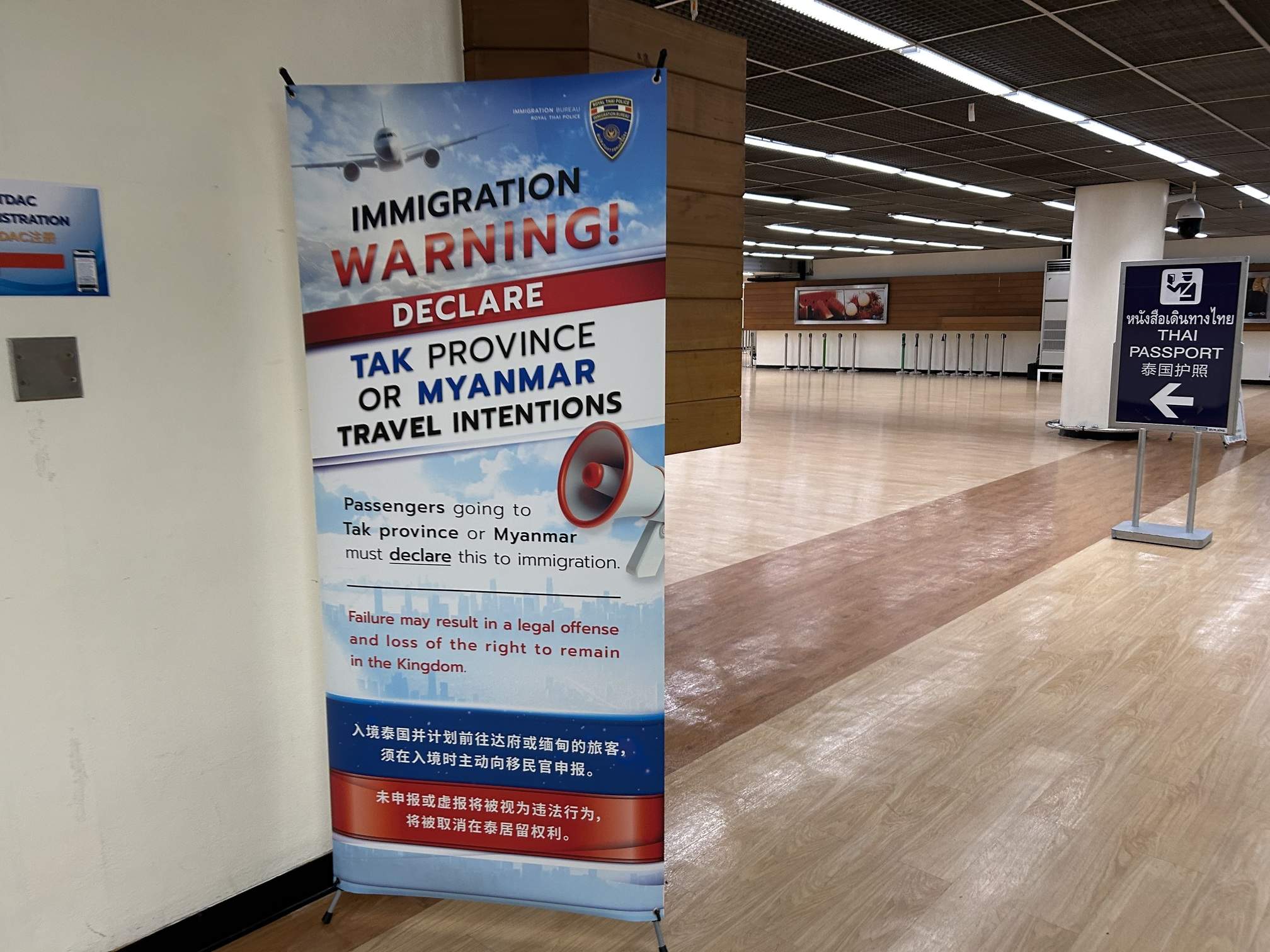
While landing at Don Mueang International Airport recently, a specific sign caught my attention, immediately triggering my “curiosity alert.” The signage requested travelers to declare their intention to travel to Tak Province (Thailand) or Myanmar.
Given the recent surge in human trafficking cases and the shift of scam operations from Myanmar into Cambodia, I wouldn’t be surprised to see “Cambodia” added to these warning signs very soon.
For several years, a wave of “danger alerts” has surrounded Thailand. Friends back home often ask me: “Is it safe? Will I be kidnapped?” It is time to clear up the stigma. The reality isn’t about tourists being snatched off the streets of Bangkok; it is far more calculated, digital, and sinister than that.
The “Job Scam” Trap: A 2026 Reality
The explosive growth of border call-center scams reached a fever pitch around 2021, but in 2026, the tactics have evolved. The danger isn’t aimed at the average tourist; it targets those lured by “suspiciously high-remuneration” job offers.
How the scam actually works:
- The Lure: Scammers post fake job descriptions with incredible pay. It isn’t just strangers doing the luring, either. In a tragic case that made headlines in early 2026, a Chinese influencer was lured by her own boyfriend with the promise of a better life; she ended up stranded in a compound in Cambodia with a fractured leg.
- The “Wang Xing” Case: Professionals aren’t immune. In January 2025, Chinese actor Wang Xing was kidnapped after being tricked into a fake “film casting” in Thailand. He was driven from Bangkok to Mae Sot (Tak) and smuggled across the river into Myanmar’s notorious KK Park. He was only rescued after his girlfriend’s social media campaign went viral.
- The Snatch & Smuggle: Once the victim arrives, “employers” confiscate their passport under the guise of “visa processing.” They are then smuggled across the Moei River into compounds where they are forced to work as scammers themselves.
📍 The 2026 Shift: From Myanmar to Cambodia
According to a January 2026 report from the Royal Thai Police’s Anti-Cyber Scam Centre (ACSC), these gangs are on the move. Due to heavy crackdowns in Myanmar, many operations have shifted to Malai in Banteay Meanchey province, Cambodia—located about 50 kilometers inland from the Poipet border.
The Government’s “Last Line of Defense”
That sign at Don Mueang is the Thai government’s final attempt to intervene. By asking travelers to declare their intention to visit high-risk border areas like Mae Sot, authorities are trying to spot potential victims of human trafficking before they lose their freedom.
My Take: While the sign makes reporting sound mandatory, a casual tourist visiting Tak for its beautiful mountains is unlikely to face legal issues for not declaring. However, the “mandatory” tone is a psychological tactic—a “speed bump” designed to make a potential victim pause and think.
🛡️ The Verdict: How to Stay Safe
If you are coming to Thailand for Pad Thai, temples, and beaches, you are safe. But if you are coming for a “dream job” or a “romance” that sounds too good to be true, follow these rules:
- Verify Directly: Never trust a recruiter on WeChat or Telegram. Look up the company’s official contact details and call them yourself.
- Keep Your Passport: Never hand your passport to anyone other than official immigration officers.
- Share Your Location: Ensure someone back home has your live location and a “check-in” schedule.
🚩 The “Red Flag” Checklist: Is Your Job Offer a Scam?
If you are considering a job offer in Southeast Asia (especially in Thailand, Myanmar, Cambodia, or Laos), ask yourself these questions. If you answer “YES” to even one, proceed with extreme caution.
1. The “Too Good to Be True” Offer
- [ ] Is the salary significantly higher than average ($3,000–$5,000 USD for basic data entry)?
- [ ] Does the job require “no experience” despite the high pay?
- [ ] Are they offering “free travel, housing, and food” for a low-level role?
2. Suspicious Communication
- [ ] Was the interview conducted entirely over Telegram, WhatsApp, or WeChat?
- [ ] Did the interview feel “too easy” (no technical or HR rigor)?
- [ ] Does the recruiter use a Gmail/Outlook account instead of a corporate domain?
3. Red Flags in Logistics
- [ ] Are you entering on a Tourist Visa with a promise to “convert it later”? (Legitimate work visas are almost always processed before arrival).
- [ ] Is the destination a border town like Mae Sot, Myawaddy, or a Special Economic Zone (SEZ)?
- [ ] Are they insisting on a “private car” to drive you several hours to a remote site?
🚨 What to do if you are already in Thailand
If you have arrived and something feels wrong—if the car is heading toward the border or they ask for your passport—DO NOT GET IN THE VEHICLE.
- Call the Tourist Police: Dial 1155 (English speaking).
- Run to a Public Place: Go to a major mall, a police station, or back into the airport terminal.
Remember: A legitimate job will never require you to cross a river in the middle of the night or give up your identification.